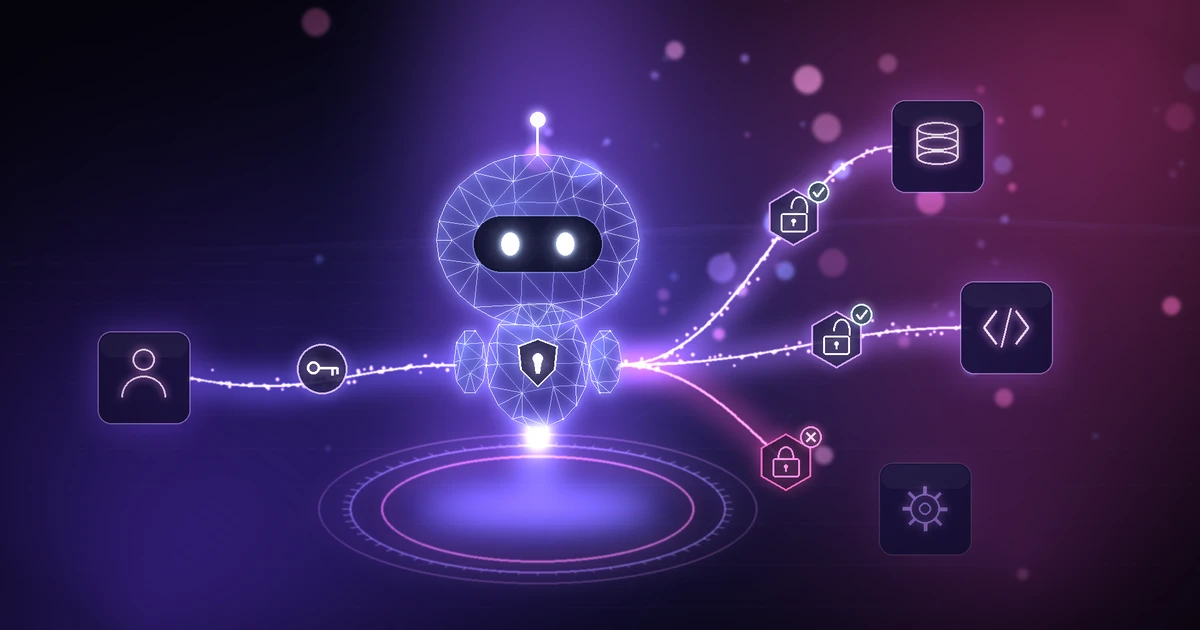
AI agent authorization decides what an AI agent is permitted to do, on whose authority, and under which conditions, at the moment it attempts each action. For autonomous agents that decision cannot be made once and reused. An agent retrieves data, calls other agents, invokes tools and APIs, and takes actions that may sit several steps away from the person who started the task. Authorization has to follow that workflow, reflecting the agent's identity, the authority it carries, the context of the request and whether the data involved can be trusted.
Why AI agents need a different authorization model
Identity and access management was designed around a short chain: a person, an identity, a set of permissions, an application and its data. Agentic AI stretches that chain into something closer to person, agent, agent, tool, API, data and action. The person who initiated the work may be several hops from the transaction that finally executes, and the conditions around the request change at each hop.
Knowing who an agent is and which permissions it holds does not settle whether a particular action should proceed. That depends on relationships, purpose, data sensitivity, consent, provenance and trust. An agent may hold permission to read a dataset and still have no business using it for the task in front of it. These are context and trust decisions, and agents make them continuously, at machine speed.
Static entitlements and long-lived, broadly scoped credentials compound the problem. A valid credential shows that an agent may connect. It says little about whether the next request fits the task, stays within the delegating user's authority or relies on data that is current and trustworthy.
Where an AI agent's authority comes from
Agents should not act through a borrowed human identity. An agent operating on a user's credentials inherits everything that person can reach, and its actions become indistinguishable from the user's in system logs. Security teams then lose the ability to limit, monitor or revoke the agent independently of the person it works for.
AI agent authorization starts by treating agents as first-class identities, distinct from the humans and systems that task them. Authority then flows through explicit delegation: a person or process grants an agent authority for a defined purpose, and that grant becomes part of every decision that follows. When the agent hands work to another agent or tool, the authority it passes on stays connected to the original actor and narrows to the task. Delegated authority for AI agents covers how that chain is preserved.
How AI agent authorization works at runtime
Runtime authorization makes policy part of execution. Each time an agent queries data, calls a tool or triggers an action, the request is evaluated against live context before it proceeds. The decision can draw on the identity of the agent and who it represents, the authority delegated to it and the scope of that delegation, the relationships between the requester and the resources involved, the purpose of the task, the sensitivity, provenance and trustworthiness of the data, and the policies that apply.
Because each decision is made against current context, authorization adapts as conditions change, and a permission granted at the start of a session does not carry the agent through everything that follows. The same evaluation applies at agent-to-agent, model-to-API and model-to-data interactions, so control holds across the full execution path. Intent-based access control adds a further check that each action still fits the purpose the agent was given.
The policy models behind these decisions are covered in fine-grained authorization for AI agents, and their application to data in AI agent access control.
Carrying authorization context across agent workflows
Authorization becomes harder when a task passes through several agents, tools and systems. Each hop is a point where authority can be lost, expanded or applied to a purpose it was never granted for. A downstream service that sees only a shared agent identity cannot tell whose request it is serving or what that person is entitled to.
The remedy is to keep context available as the transaction progresses. Identity, delegation, relationships, data sensitivity, provenance and purpose stay attached to the workflow, so each decision reflects both the immediate request and the wider chain behind it. NIST's work on AI agent identity and authorization points in the same direction, highlighting delegation standards, Transaction Tokens for carrying authorization context across call chains, and AuthZEN as a standard interface between enforcement and decision points. A practical security model for agentic AI maps that guidance to IndyKite's architecture.
Explaining why an action was authorized
Agents operate faster and at greater scale than people can supervise, and NIST cautions against treating human-in-the-loop approval as the primary safeguard, since repeated approval requests lead to consent fatigue. Policy enforced at runtime resolves routine decisions automatically, with escalation reserved for the situations that genuinely need a person.
That model depends on every decision leaving evidence. Security, governance and compliance teams need to see who or what initiated an action, what authority was involved, which data and policies applied, and why the action was allowed. When that record is captured as part of the decision itself, each agent action can be traced back to the provenance, context and policy that permitted it. AI agent audit trails covers what the record needs to contain.
How IndyKite approaches AI agent authorization
The IndyKite Identity Knowledge Graph makes humans, machines and AI agents first-class identities and connects them to the data, systems and other entities around them. It captures relationships such as ownership, delegation and consent alongside signals including purpose, provenance and trust. With that context, an authorization decision can establish who an agent represents, how it relates to the resources involved and whether the information it is acting on can be trusted.
IndyKite works alongside existing identity infrastructure. Credentials establish who is acting; IndyKite determines what that actor may do in the current context. Knowledge-Based Access Control (KBAC) is the dynamic policy decision layer, evaluating identity, relationships and context to make fine-grained decisions at runtime, with native AuthZEN support and compatibility with OAuth and OpenID Connect. AgentControl applies those decisions across agent workflows, and its Agent Gateway preserves identity and delegation context as agents interact with tools, data and services. The Intent Agent translates natural-language requests into structured authorization statements, so the purpose of a task can be evaluated alongside identity and policy.
The result is authorization that follows the workflow, from the original delegation through each decision and action to the record of why it was permitted.
FAQ
What is the difference between AI agent authorization and authentication?
Authentication verifies an agent's identity, usually through existing identity providers and credentials. Authorization decides what that agent may do, for whom and under which conditions. For agents, most of the risk sits in the second decision, because it has to be made again at every step of a workflow.
Should AI agents use the user's permissions?
No. An agent acting under a user's identity inherits all of that user's access and cannot be distinguished from them in logs or policy. Agents should hold their own identity, with authority explicitly delegated by the user, scoped to a purpose and revocable without affecting the person. See least privilege for AI agents.
How does AI agent authorization relate to fine-grained authorization?
Fine-grained authorization describes the precision of a decision: a specific action, on a specific resource, under specific conditions. AI agent authorization covers the wider question of an agent's authority, including where it comes from, how it is carried across a workflow and how it is evaluated at each action. Fine-grained policy is one of the mechanisms it depends on.
What does NIST say about AI agent authorization?
NIST's guidance calls for agents to be treated as distinct identities, for delegated authority to be preserved, for access to be granular and least-privilege, and for authorization context to move across agent chains. It points to standards including OAuth 2.0, SPIFFE, Transaction Tokens, Rich Authorization Requests and AuthZEN.



.webp)